
Why “data quality” still feels like a boring topic (and why that’s a problem)
Let’s be honest: data quality rarely excites anyone.
It doesn’t sparkle like “AI,” it doesn’t have the cool buzz of “digital twins,” and it doesn’t sell itself in board meetings.
But here’s the uncomfortable truth:
Every single AI use case, every dashboard, every automation you want to build — stands or falls with the quality of your data.
And according to recent industry studies, nearly 80% of companies can’t accurately assess the current state of their data health.
They assume it’s “fine” — until the first project fails.
The silent cost of low-quality data
Bad data doesn’t just lead to wrong decisions. It quietly eats your company’s time, budget, and trust.
- Teams spend hours reconciling mismatched numbers across systems.
- Managers lose confidence in reports because they never match reality.
- IT departments firefight endless “Why is this figure wrong?” tickets.
Gartner once called it the hidden tax on digital transformation.
We see that every day in our consulting projects — especially when companies start to prepare their data for AI or advanced analytics.
The pattern is always the same:
Great vision, solid tech stack… and then a data foundation full of duplicates, missing context, or outdated definitions.
What “data health” actually means
At Dategro IT, we use the term data health very deliberately.
It’s not just about “clean data.” It’s about usable, trusted, and connected data.
Think of it as four pillars:
- Accuracy — Is the data correct and verified?
- Consistency — Does it match across systems (CRM, ERP, Finance)?
- Context — Is it enriched enough to be useful?
- Connectivity — Does it flow between systems or live in silos?
When even one of these pillars breaks, your AI models, dashboards, and decisions start to wobble.
Measuring data health — not guessing it
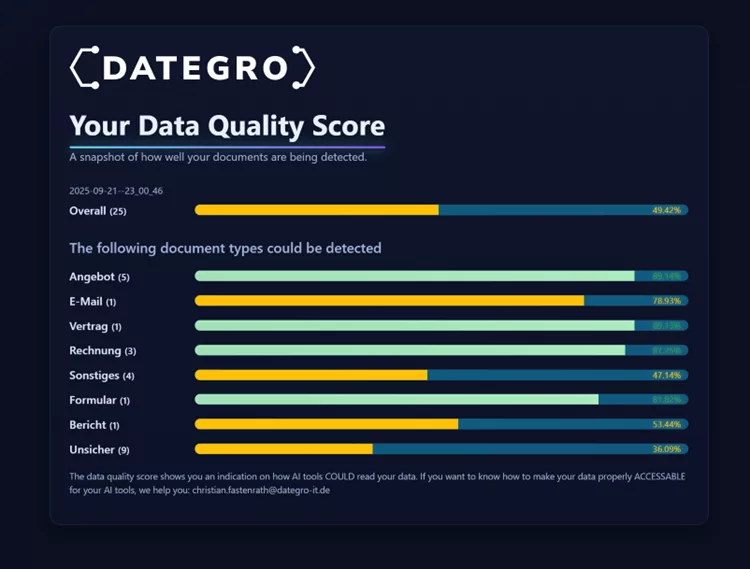
We built the Dategro DataDashboard to give teams a simple, visual way to see how their data is doing.
No jargon, no black-box audit — just a measurable score across those four pillars.
It’s a bit like a fitness tracker for your data:
You can’t improve what you don’t measure.
One client in manufacturing scored 62/100 on their first assessment.
After three months of targeted cleanup and integration, they reached 82/100.
The impact was immediate — reporting stabilized, AI pilots stopped failing, and even internal trust improved.
Why integration and governance go hand in hand
Here’s something most organizations miss:
You can’t fix data quality with a governance policy alone.
If your systems are disconnected, errors will keep multiplying no matter how strict your rules are.
That’s why system integration and data management must evolve together.
Integration ensures the data flows.
Governance ensures it flows correctly.
Together, they create a living, breathing data ecosystem — not another static documentation effort that nobody updates.
Clean data, smaller footprint
An overlooked angle: good data quality also reduces your digital carbon footprint.
Duplicates, redundant storage, unnecessary queries — all of these consume compute power and energy.
By cleaning and consolidating data, you’re also building a greener IT foundation.
It’s a nice bonus: less noise, less waste, less CO₂.
So how do you close your own data quality gap?
Start small.
Pick one business process — say, customer onboarding or order fulfillment — and map where the data breaks.
Then measure it.
Ask:
- Do we trust this data enough to automate with it?
- Would we stake an AI decision on it?
If not, it’s time for a structured cleanup and monitoring plan — not a one-off project, but a continuous discipline.
Final thought
You can’t build AI on shaky ground.
Before you add another tool or model, make sure your data foundation is healthy enough to carry it.
Data quality isn’t the most glamorous part of digital transformation — but it’s the one that makes everything else possible.

Ready to Transform on Your Terms?
We specialize in designing sales and marketing transformation initiatives that enhance your technology ecosystem rather than creating additional technical burden.
Contact us today to discuss how to accelerate your digital transformation journey without compromising system integrity.
Dategro partners with mid-sized industrial companies to transform disconnected commercial data into unified performance dashboards—without replacing core systems or creating IT headaches.