
What is the EU Data Act?
The EU Data Act is an EU regulation that came into force on January 11, 2024, and has been valid law in the EU since September 12, 2025. It is a cornerstone of the European data strategy and aims to ensure that data – especially from connected products and services – becomes fairer, more secure, and more usable for businesses, users, and innovation.
Essentially, the Data Act regulates who can access which data, how data may be shared, and how fair conditions for data exchange can be created. The focus is particularly on non-personal data generated when using digital products, from industrial machines to IoT devices.
What does this mean for companies?
Companies that manufacture connected products or manage data from digital services are facing profound changes:
Data access for users and third parties: Users are granted rights to access data generated through their use. Companies must provide technical and organizational mechanisms to enable this access.
Fair contract clauses: Provisions that restrict data access and use should be fair and transparent. Unfair clauses may become invalid.
Cloud flexibility: Switching between cloud providers should become easier in order to reduce technological dependencies.
Public access in crises: Authorities may request data under special circumstances, which requires internal governance processes.
For management, this means rethinking data strategy rather than just adapting it. The greatest potential lies not in the mere obligation to implement, but in building data-driven services, platforms, and ecosystems that create competitive advantages.
Practical challenges
Implementing the Data Act is not simply a matter of “adding an interface.” It affects a company’s entire data and system architecture:
- Secure and controlled data access for third parties
- Governance, auditing, and policy management
- Integration into existing product and IT landscapes
This presents a major strategic challenge – but also an opportunity for those who can master and operationalize this complexity.
Dategro as your partner for Data Act transformation
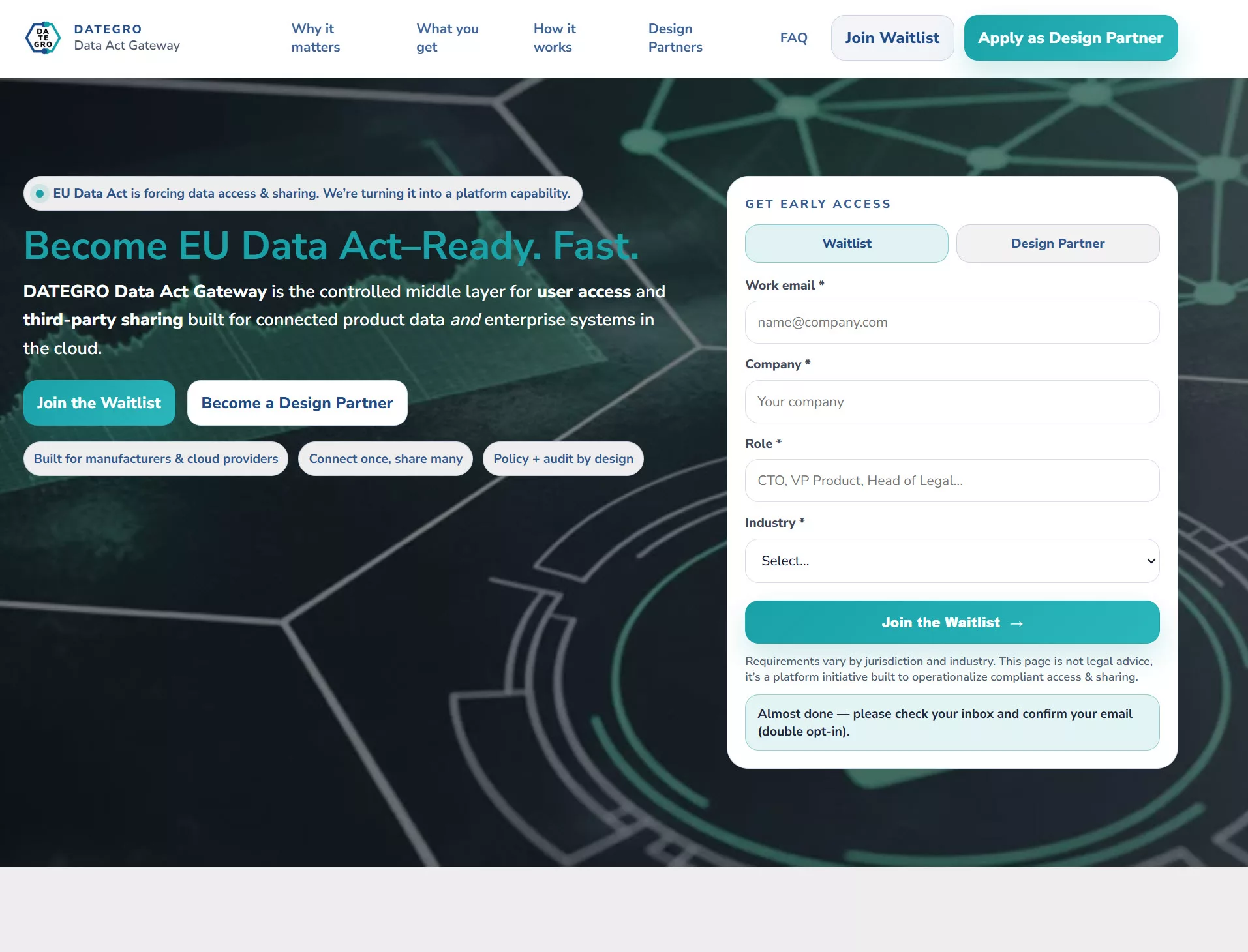
This is precisely where the Dategro Data Act Gateway comes into play. With the Data Act Gateway, Dategro aims to build a platform-enabled solution that helps companies implement the requirements of the Data Act in an operational, secure, and scalable manner.
Instead of selective, individual integrations, the Data Act Gateway creates a controlled middle layer through which networked data from products and enterprise systems can be efficiently accessed and shared. It addresses identity & ownership, consent management, policy enforcement, and auditing – all important building blocks for not only fulfilling Data Act obligations, but also turning them into a strategic strength.
Conclusion: Data Act as a strategic competitive advantage
The EU Data Act is more than just a law – it is an impetus for transformation. For C-level executives, this means:
- Proactive data strategy instead of pure compliance management
- Tapping into new data-based business models
- Building technical and organizational data capabilities
With partners like Dategro, this change becomes an opportunity rather than a burden – an opportunity for innovation, growth, and real data value.

Ready to Transform on Your Terms?
Use the EU Data Act as a strategic lever rather than a mere compliance obligation.
Work with Dategro now to find out how you can future-proof data access, governance, and new business models – and translate regulatory requirements into sustainable competitive advantages.
Dategro partners with mid-sized industrial companies to transform disconnected commercial data into unified performance dashboards—without replacing core systems or creating IT headaches.