
Without a Data Logistics System, there is no digital future
Do you know this situation?
Every new interface feels like a mini-project. Data is scattered across ERP, CRM, cloud, and specialized tools. Information rarely arrives where it is needed. And when it finally does, the integration was expensive and slow.
The result: innovation slows down, costs rise – and Artificial Intelligence remains a dream because the data foundation is missing.
This is where a Data Logistics System (DLS) comes in: it brings order to data chaos and makes your company ready for the digital future.
What is a Data Logistics System (DLS)?
A Data Logistics System is the backbone of modern data infrastructure:
- It connects systems and applications across business units and partners.
- It ensures that data flows securely, reliably, and traceably.
- It reduces integration effort and creates a unified foundation for innovation.
For comparison: A Document Management System (DMS) organizes and manages documents. A DLS goes one step further – it organizes all data flows across the company. Where a DMS creates order in the document archive, a DLS creates order on the data highway. It complements existing systems such as ERP and DMS and elevates them to a new level.

The digital freight yard: how DLS works in practice
Think of your corporate data like goods that need to be transported. Today, this often looks like a patchwork of small direct connections, detours, and duplicate transports.
A DLS works like a modern digital freight yard:
- All data trains arrive at a central point.
- They are sorted, secured, and placed on the right track.
- Autonomous transport units – with the intelligence to know where each piece of data needs to go.
- Every shipment reliably reaches its destination – whether it is an ERP system, an IoT platform, or an AI service.
The result is an organized, scalable, and secure data logistics system.
The 5 pillars of a successful AI data strategy
For Artificial Intelligence to create real business value, the data foundation must be right. Five success factors decide whether a company is AI-ready:
1. System Integration – break down silos, connect ERP, CRM, cloud, and on-prem systems.
2. Data Quality – only complete, accurate, and up-to-date data builds trust.
3. Governance – clear roles, processes, and responsibilities.
4. Compliance – GDPR-first design, protecting sensitive data across its lifecycle.
5. Single Source of Truth – shared dashboards and reporting for faster, aligned decisions.
A DLS provides the technological foundation to make these five pillars work in practice.
Benefits from three perspectives
A Data Logistics System convinces not through fear, but through opportunities and potential. Decision-makers recognize for themselves why it creates value.
For CIOs and CTOs
- Speed: New use cases and integrations in weeks instead of months.
- Cost control: Fewer interfaces, less maintenance, lower support costs.
- Security: Unified encryption and governance instead of dozens of isolated solutions.
For CEOs
- Innovation driver: AI and automation finally become feasible.
- Investment protection: Existing systems are preserved and seamlessly integrated.
- Growth: Faster product launches, improved customer experiences, and new business models.
Real-world examples: how companies benefit
- Manufacturing: IoT data from machines is connected with ERP and MES → predictive maintenance and less downtime.
Customer impact: More reliable products, stable delivery times, proactive service. - Financial services: A central data platform that complies with GDPR → AI-powered risk analysis and regulatory compliance.
Customer impact: Greater security, better advice, and trust in data handling. - E-commerce: Customer data from CRM, webshop, and marketing tools comes together → personalized offers in real time.
Customer impact: Relevant product recommendations, less spam, faster service.
Everywhere the pattern is the same: without integrated data logistics, AI remains fragmented. With a DLS, companies build a solid and reliable foundation.
Conclusion
Any discussion about AI, automation, or digital services must begin with one thing: data flows.
A Data Logistics System is the key. It transforms a patchwork of connections into a stable, secure, and future-proof data platform.
This is how your company becomes not only more efficient, but also more innovative.
Our Intelligent Data Logistics System (IDLS) – your digital freight yard
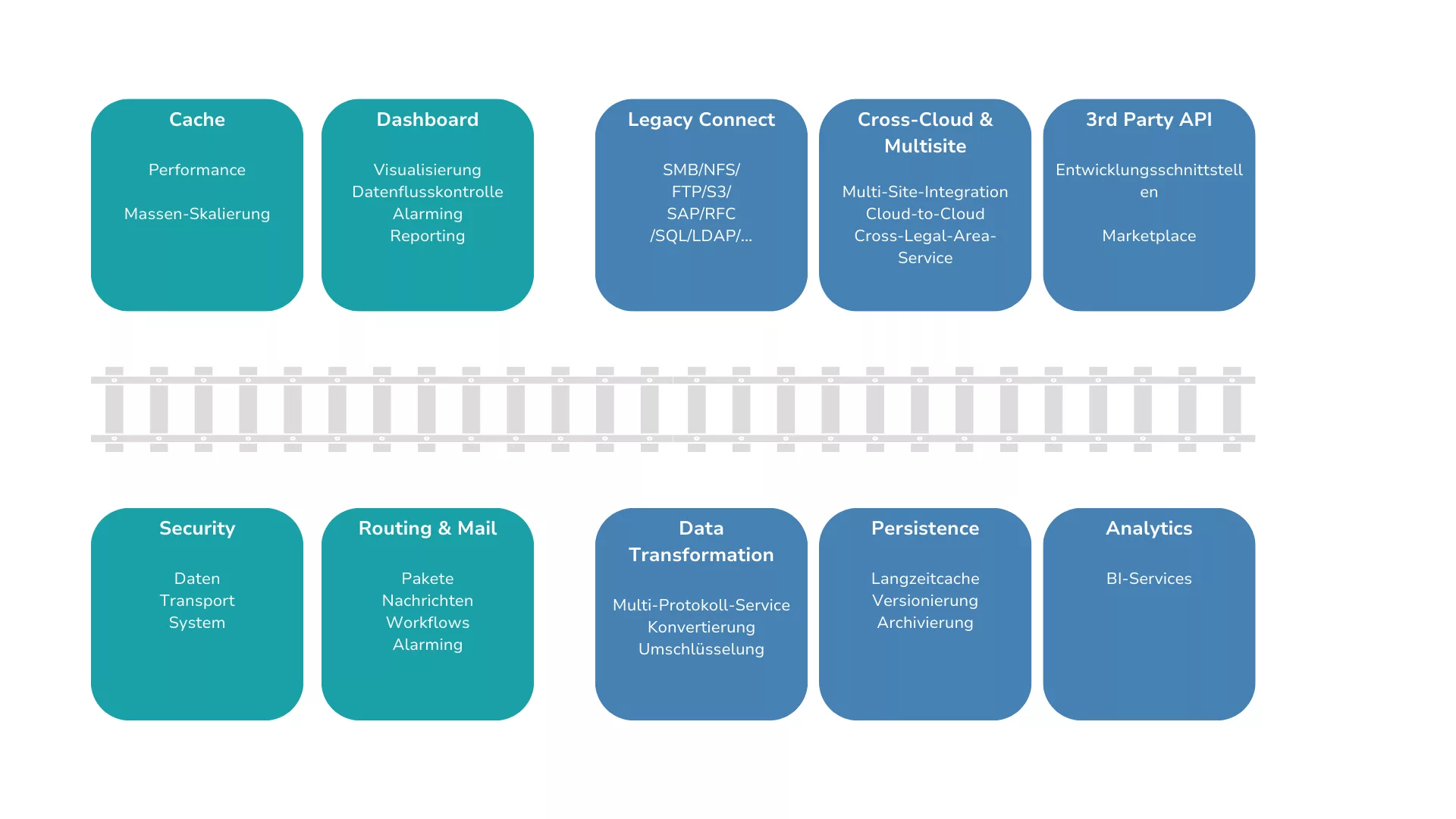
This diagram shows the wide range of services provided by our Intelligent Data Logistics System (IDLS) – from security and transformation to analytics, multi-cloud integration, and APIs.
With the IDLS, you do not get just another tool, but a central solution that controls, secures, and future-proofs your data flows.

Ready to regain control of your data flows?
If you want to learn how our IDLS can bring order to your data chaos and create the foundation for AI and digital innovation, get in touch with us.
Dategro partners with mid-sized industrial companies to transform disconnected commercial data into unified performance dashboards—without replacing core systems or creating IT headaches.